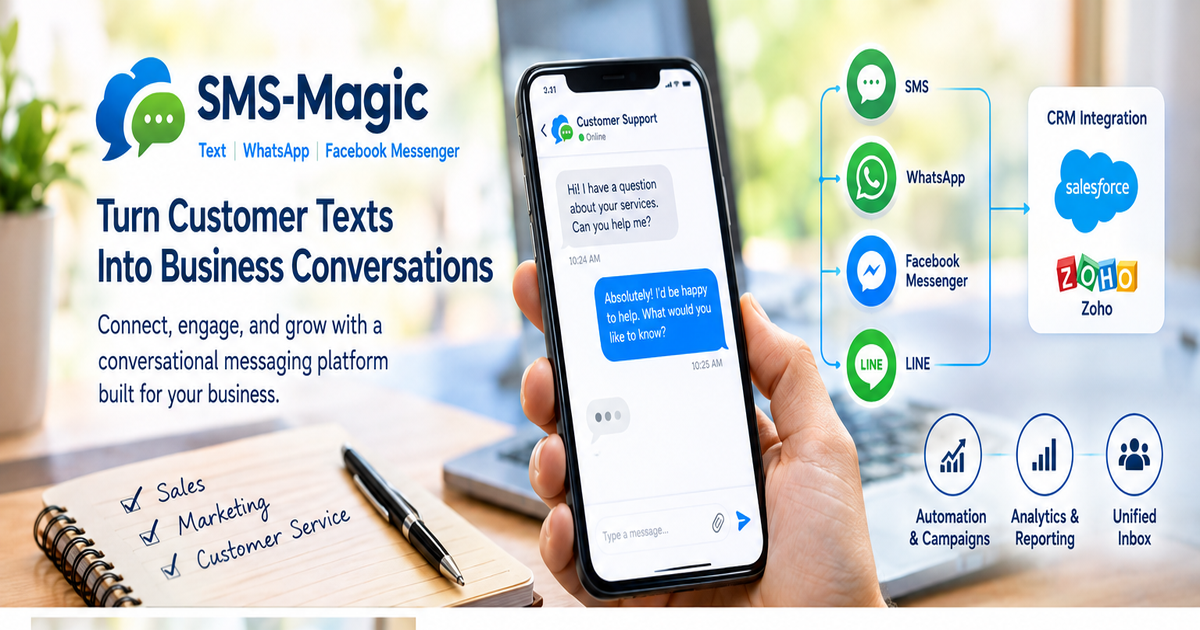
SMS-Magic: Turning Business Text Messaging Into Customer Conversations
Learn how SMS-Magic connects business messaging with CRM systems, automation, sales, marketing, and customer service while understanding its pricing structure.

Artificial intelligence is quickly becoming part of everyday business operations. Employees are using AI to write emails, analyze documents, summarize meetings, research ideas, create presentations, automate repetitive work, and solve problems that once required hours of manual effort.
But as AI adoption grows, another problem is emerging. Businesses can end up with employees using different AI tools, multiple subscriptions, disconnected workflows, and sensitive information moving through systems that IT may not control.
For small and medium-sized businesses, this can create a difficult balance. They want the productivity benefits of AI, but they also need security, privacy, cost control, and a practical way to manage how AI is being used.
That is where Hatz AI enters the conversation.
Instead of requiring a business to select one AI provider and build its operations around that single model, Hatz AI is designed around a multi-model approach.
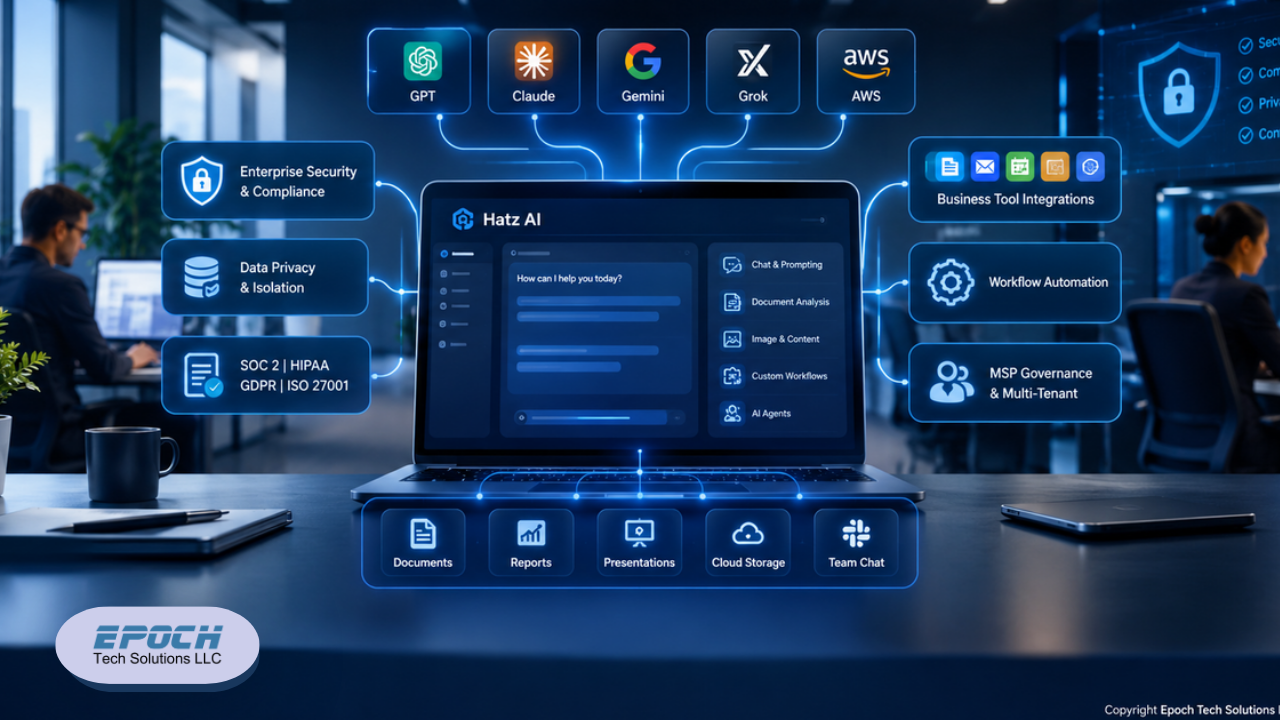
The platform provides access to more than 50 major large language models, including models from OpenAI, Anthropic, Google, Grok, and Amazon. The idea is simple: different AI models can have different strengths, so businesses should have the ability to select the right engine for the job.
An employee might use one model for writing, another for analysis, another for research, and another for a specialized workflow. Rather than maintaining a collection of separate subscriptions and interfaces, Hatz AI brings those capabilities together under one environment.
For an SMB, that can make AI easier to adopt. For an MSP, it can create a more manageable way to deliver AI capabilities across multiple clients.
The excitement surrounding AI often focuses on what the technology can do. Businesses, however, also need to ask where their information goes and how that information is handled.
Hatz AI is positioned as a secure AI platform with data privacy and isolation at its core. Its stated approach is designed to prevent customer data from being used to train public AI models.
The platform is also positioned around compliance requirements associated with frameworks and regulations such as SOC 2 Type 2, HIPAA, GDPR, and ISO 27001.
For organizations working with confidential customer information, financial records, healthcare information, legal documents, or proprietary business data, security cannot be an afterthought. AI needs to fit inside the organization's existing security and governance strategy.
That makes secure AI particularly important for businesses that want their employees to use AI without creating a new shadow-technology problem.
One of the more interesting aspects of Hatz AI is its no-code workshop.
Traditional automation projects can require developers, integrations, APIs, testing, and ongoing maintenance. That approach can be powerful, but it can also make automation difficult for smaller organizations without dedicated development resources.
Hatz AI takes a different approach by allowing users to create workflows, agents, and automated tasks using natural language instructions.
Imagine a company preparing for the next business day. Instead of an employee manually reviewing calendars, documents, messages, and other information, a workflow could be designed to gather relevant information and produce a meeting briefing.
That briefing could then be delivered directly through a business communication platform such as Slack or Microsoft Teams.
The result is not simply an AI chatbot. It becomes an operational assistant that can participate in repeatable business processes.
AI becomes significantly more valuable when it can work with the systems a company already uses.
Hatz AI is designed to connect with business platforms such as Salesforce, HubSpot, Slack, Microsoft 365, Notion, and Google Workspace.
These integrations can help move AI from an isolated tool into the broader business environment.
Consider a sales team. Instead of asking an employee to manually gather information before a customer meeting, an AI workflow could potentially bring together relevant customer information, previous interactions, notes, and other available business data.
The same concept can apply to marketing, operations, customer service, administration, and management.
The goal is not simply to give employees another application. The goal is to make existing business information more useful.
Secure AI chat is still an important capability. Employees can ask questions, summarize documents, research topics, analyze information, and experiment with different AI models.
But the larger opportunity may be automation.
A business can identify repetitive processes and ask a more important question: Could AI perform some or all of this work automatically?
That could include preparing daily reports, summarizing documents, organizing information, creating presentations, generating charts, preparing meeting briefings, or transforming data into a branded deliverable.
When these processes become repeatable workflows, AI can move from being an employee productivity tool to becoming part of the company's operating infrastructure.
The MSP market presents an especially interesting use case for Hatz AI.
Managed service providers already help businesses manage technology, cybersecurity, cloud services, systems, and infrastructure. AI introduces another layer of technology that clients increasingly need help understanding and controlling.
Employees may already be using public AI tools without consulting IT. This creates what is commonly called shadow AI.
An MSP can potentially address this problem by providing a controlled AI environment, establishing policies, selecting appropriate models, and helping clients build useful AI workflows.
Hatz AI's multi-tenant and administrative capabilities are designed to support this type of MSP-oriented model.
Instead of simply telling clients which AI tools they can or cannot use, an MSP can help provide a secure environment where AI becomes part of a managed technology strategy.
For a smaller business, the appeal is largely about simplicity.
Instead of purchasing and managing numerous AI subscriptions, a company can have access to multiple models through a single platform. Instead of hiring developers for every automation idea, employees can use a no-code environment to create workflows.
Instead of allowing employees to independently determine how sensitive business information is handled, leadership and IT can establish a more centralized approach.
This combination can make AI adoption less fragmented.
It also provides a path for businesses that may not have the resources of a large enterprise but still need enterprise-oriented security and control.
Even the best AI platform cannot create value if employees do not use it.
One of the biggest challenges for any business AI initiative is adoption. Employees need to understand what the technology can do, when they should use it, and how it fits into their daily responsibilities.
Businesses also need clear internal policies.
Employees should know which information can be entered into AI systems, which workflows are approved, how AI-generated information should be reviewed, and who is responsible for maintaining automated processes.
For MSPs, this creates an opportunity to become more than a technology provider. An MSP can become an AI advisor, helping clients identify practical use cases, establish governance, train employees, and measure results.
It can be viewed as both.
For an SMB, Hatz AI can provide centralized access to multiple AI models, secure business AI capabilities, integrations, document analysis, workflow automation, and custom AI applications.
For an MSP, the platform can provide another layer of managed technology that can be packaged, governed, customized, and delivered across client environments.
That dual focus is one of the characteristics that separates Hatz AI from general-purpose consumer AI products.
A single AI assistant can be extremely useful, but a business may eventually need more than a standalone chatbot.
Hatz AI's differentiating idea is the combination of multi-model access, security, business integrations, no-code automation, custom AI applications, and MSP-oriented management.
The question therefore becomes less about which AI model is the best and more about how a business can safely use multiple AI capabilities as part of its operations.
For organizations evaluating AI adoption, Hatz AI is worth considering when security, centralized management, multiple AI models, integrations, and workflow automation are important requirements.
The strongest potential fit is for businesses that want to move beyond basic AI experimentation and begin building repeatable AI-powered processes.
For MSPs, the opportunity may be even broader. AI is becoming another area where clients need guidance, governance, implementation, and ongoing support.
The businesses that benefit most from AI will likely not be the ones that simply give employees access to a chatbot. They will be the ones that thoughtfully connect AI to their people, processes, systems, and data.
Hatz AI represents one approach to making that transition.
AI adoption is entering a new phase.
The first phase was experimentation. Employees discovered what AI could do.
The next phase is integration. Businesses are connecting AI to the systems and processes they already rely on.
The phase after that is operationalization. AI becomes part of the way the business actually works.
That is where platforms such as Hatz AI become particularly interesting. By bringing multiple models, security, integrations, automation, and governance into a single business-oriented environment, the platform is designed to help organizations move from asking AI questions to building AI-powered operations.
For SMBs and MSPs, that shift could be the difference between simply using AI and actually building a business around it.
Hatz AI is positioned as a secure, multi-model AI-as-a-Service platform designed specifically around the needs of SMBs and MSPs.
Its combination of access to multiple AI models, enterprise-oriented security, no-code workflow creation, business integrations, document and data capabilities, and MSP management gives organizations a path toward more controlled and practical AI adoption.
The most important question for a business may no longer be whether it should use AI.
The better question is how it can use AI securely, strategically, and repeatedly to improve the way the business operates.
For businesses ready to answer that question, Hatz AI is a platform worth evaluating.