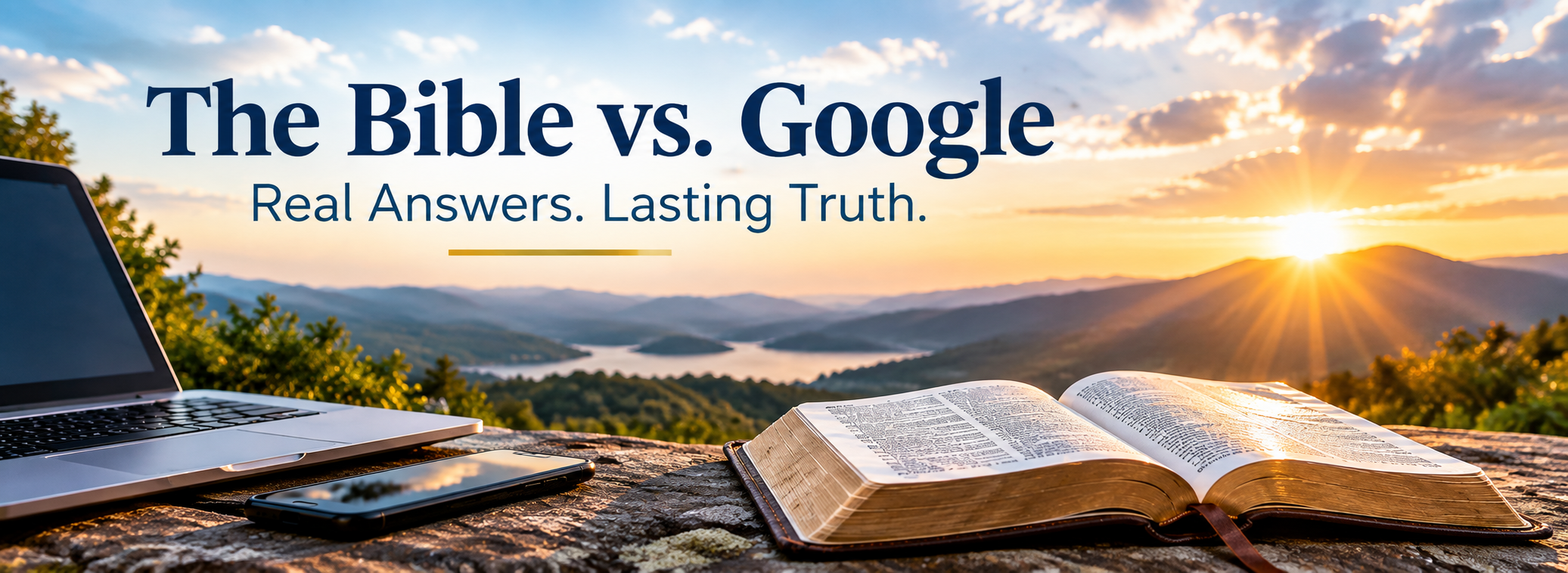
“Google it.”
Those two words have become part of everyday conversation. When we have a question, we reach for our phone. When we need directions, we search online. When we want to know how something works, we ask a search engine. When we are trying to make a decision, we often look for someone else who has already asked the same question.
Technology has made information easier to find than at any other time in history.
But there is an important question we should ask ourselves: Has having instant access to information changed where we look for truth?
God predates Google.
Long before search engines, smartphones, computers, and the internet, people were searching for knowledge. They gathered in homes, public spaces, churches, meeting places, and other social settings. They shared stories, discussed ideas, listened to teachers, read books, and exchanged newly accessible printed materials.
Those sources could be helpful, but they could also introduce people to ideas that challenged their beliefs. Some strengthened Christian faith, while others promoted ideas that were openly opposed to Christianity.
In many ways, the technology has changed, but the human desire for answers has not.
What has changed is the speed, volume, and accessibility of the information surrounding us.
Today, we can ask almost any question and receive thousands of answers within seconds. We can find opinions from people around the world. We can read articles, watch videos, listen to podcasts, and scroll through social media posts from people we have never met.
Yet there is a difference between finding information and finding truth.
For Christians, that distinction matters.
For generations, the Bible has been a divine location for answers. Scripture provides a place to seek God's truth, wisdom, instruction, and guidance. While the world around us continues to change, God's Word provides an unchanging foundation for faith.
Perhaps the question is not whether we should use Google.
Perhaps the better question is:
Where should we go first?
The Search for Answers
Imagine that you are facing a difficult decision.
You are uncertain about what to do. You are worried about the future. You need wisdom. You want to know whether a particular choice is right or wrong. What is your first reaction? For many of us, it is almost automatic. We reach for our phone and begin searching.
We type a question into Google and immediately receive page after page of answers.
One person says one thing. Another person says something completely different. A professional offers an opinion. A blogger shares a personal experience. A social media influencer provides advice. Someone else argues that all of them are wrong. Eventually, we may have more information than we started with, but we may not have any more wisdom. That is the problem with confusing information with truth.
Google can help us find information, but a search engine cannot determine spiritual truth for us.
Truth vs. Human Opinion
The internet contains an enormous amount of knowledge. It also contains an enormous amount of opinion. Anyone can publish something online. A person does not necessarily need formal training, experience, or authority to create an article, video, post, or comment. That does not make everything online wrong.
It simply means we must be careful about what we accept as truth.
Divine Origin
For Christians, the Bible is not simply another book containing someone's opinion. The Bible is God's Word and provides the foundation for understanding His character, His promises, His commands, and His relationship with humanity. When we open Scripture, we are intentionally turning toward the source of the spiritual truth we are seeking.
That is fundamentally different from scrolling through competing opinions and trying to decide which one sounds the most convincing.
Human Bias
Google can give us thousands of answers to the same question because those answers come from thousands of different people and perspectives.
People bring their experiences, beliefs, assumptions, emotions, and worldviews into the information they create. One person may tell us that something is right. Another may tell us that the same thing is wrong. One source may tell us to follow our feelings. Another may tell us to follow society. Another may tell us to follow science. Another may tell us to follow tradition. Eventually, the search for an answer can become a search through competing human voices.
More information does not necessarily produce more wisdom.
Sometimes, it simply produces more voices.
Spiritual Safety
What we repeatedly consume can influence what we think about. What we think about can influence what we believe. And what we believe can eventually influence how we live. This is especially important when it comes to spiritual questions.
The internet contains many valuable Christian resources, but it also contains ideas that can challenge, distort, or contradict biblical teaching.
That does not mean Christians should avoid technology. It means we should approach technology with discernment. We should know the difference between using the internet as a tool and allowing the internet to become our authority.
Guidance and Relationship
The Bible is more than an information source. It points us toward a relationship with God. When we open Scripture, we are not simply looking for facts. We are seeking to understand who God is, what He has said, and how His Word applies to our lives.
That relationship changes the way we approach our questions.
Personal Connection
Prayer and Scripture belong together. We read God's Word, think about what we have read, and then bring our questions, concerns, burdens, and gratitude to God through prayer.
Philippians 4:6–7 encourages believers to bring their worries and requests to God through prayer and thanksgiving. The passage points us toward the peace of God rather than allowing anxiety to control our hearts.
That is something a search engine cannot provide.
Google can provide another answer.
God offers a relationship.
Life Direction
When we face a decision, the internet can tell us what other people think. Scripture can help us examine our decisions in light of God's character and His instruction. That difference is important. We are not simply trying to determine what is popular. We are trying to determine what is right. We are not simply asking, “What does everyone else think?” We are asking, “What does God say?” Turning to Scripture first can provide a sense of peace and moral direction that a search engine cannot provide.
Reliable Wisdom
The world around us changes constantly.
Technology changes. Culture changes. Opinions change. Social expectations change. What is considered acceptable today may be viewed very differently tomorrow.
God's Word provides a foundation that Christians can continually return to.
The question is not whether technology is useful. Technology can be incredibly useful.
The question is whether we have allowed technology to become our first source of wisdom when God should be our first source of spiritual direction.
How Do We Search the Bible for Answers?
There is another important point to consider. If we are going to turn to the Bible for answers, we should learn how to study it carefully. Searching the Bible does not mean finding one verse that contains a particular word and immediately deciding that we have discovered the complete answer.
Scripture deserves more than a quick search.
-It deserves our attention.
-It deserves context.
-It deserves prayer.
-It deserves patience.
Helpful Search Tools
There are many tools available to help us study the Bible.
A concordance can help us find where specific words appear throughout Scripture. A topical Bible can group passages around subjects such as love, faith, forgiveness, wisdom, and other important topics.
Digital Bible platforms and searchable databases can also help us locate passages quickly.
Study Bibles can provide additional notes, historical information, and explanations that help us understand difficult passages.
These tools can be valuable.
But the tools are not the source of truth.
They are simply tools that can help us find and understand Scripture.
The purpose remains the same:
Seek understanding from God's Word.
Check the Context
One of the most important parts of studying the Bible is understanding context.
Before accepting a verse as an answer, read the verses around it.
Ask yourself what is happening in the passage.
-Who is speaking?
-Who is being addressed?
-What is happening in the story?
-What was the author's purpose?
-What message is being communicated?
A single sentence can be misunderstood when it is removed from the larger passage. We should not treat Scripture like a collection of isolated quotes designed to answer whatever question we happen to have. We should read it as God's Word, seeking to understand the message in its proper context.
Compare Scripture With Scripture
Sometimes we will encounter a passage that is difficult to understand.
When that happens, we should not immediately assume that we have reached the end of our search.
Instead, we can look for other passages that address the same subject.
Scripture can help illuminate Scripture.
Rather than building an entire belief around one isolated verse, we can consider what the Bible teaches about that subject as a whole.
This approach requires patience.
It requires us to slow down instead of immediately searching for the quickest answer.
Learn the Background
The Bible was written to people living in particular historical, cultural, and geographic settings.
Understanding something about the original audience can help us understand what we are reading.
Learning about the circumstances surrounding a passage can provide valuable perspective.
The goal is not to replace Scripture with historical information.
The goal is to better understand what we are reading so that we do not impose our modern assumptions onto an ancient text.
Prayer and Meditation
There is another step that can easily be overlooked. After reading the Bible, pray and meditate. Prayer is communication with God. It is an opportunity to bring our requests, concerns, burdens, gratitude, praise, and confession before Him.
Biblical meditation is different from simply emptying the mind. It is about filling the mind with God's truth. Psalm 1:2 describes the person who delights in the law of the Lord and meditates on it day and night. Joshua 1:8 also connects meditation on God's Word with obedience and living according to what God has commanded.
The process can be simple.
-Read a passage.
-Slow down.
-Think about what it says.
-Read it again.
-Ask God to help you understand it.
-Consider what it means for your life.
-Then pray about what you have learned.
Let Scripture Shape Your Prayers
When we meditate on Scripture, the words we read can naturally become part of our prayers.
-A passage about God's faithfulness may cause us to thank Him.
-A passage about forgiveness may lead us to confession.
-A passage about wisdom may cause us to ask God for guidance.
-A passage about suffering may lead us to seek God's comfort.
In this way, reading the Bible becomes more than an intellectual exercise. It becomes part of our relationship with God.
Psalm 19:14 expresses this beautifully:
“Let the words of my mouth and the meditation of my heart be acceptable in your sight, O Lord.”
Put Down the Search Bar and Open the Bible
There is nothing inherently wrong with using Google. We live in a technological age, and technology can be an incredible tool. We can use it to learn, communicate, work, research, connect with others, and find useful resources. But we should remember that technology is a tool. It was never meant to become our source of ultimate truth.
When the question concerns spiritual truth, purpose, morality, faith, and our relationship with God, perhaps we should change the order in which we search.
-Before reaching for the phone, reach for prayer.
-Before accepting an opinion, search Scripture.
-Before allowing the world to tell you what is true, ask what God's Word says.
-And after reading the Bible, don't immediately close it and move on.
-Stop.
-Think about what you have read.
-Pray about it.
-Meditate on it.
-Ask God to help you understand it and live it.
-We may live in a world that tells us to “Google it,” but Christians have another place to turn.
-We can open the Bible.
-We can pray.
-We can meditate on God's Word.
-And we can seek wisdom from the One who existed long before Google ever did.
Before you Google it, pray about it.
Before you accept an opinion, search Scripture.
After reading the Bible, pray and meditate.
This brings answers to light; not because we have discovered every answer ourselves, but because we have turned our hearts toward the One who already knows the answer.